

Save Our Communities from Excessive State Control
Less taxes or less local voice?

Let me make one thing clear. I am certainly not against lowering property taxes. Neither are my fellow commissioners statewide. In fact, we’ve voted to lower our millage rate four of the past five years in Manatee County and went into this budget cycle with an explicit directive to every department: come back leaner so we can cut more. We pay these taxes too. If there’s a smart way to put money back in your pocket, I’m genuinely for it.
People love to say this is “taking money from the local officials”. No it’s not. I don’t care. I don’t own a boat. My kids are older and don’t use the parks. I rarely go to our libraries. I don’t personally need to spend this money to keep services. I’ll shut them all down if you want. But when we do (see our recent trash reduction or the outcry when we discussed closing Central Library), it’s the public that gets loud. We’re here to fund services at your request. No more, no less.
Losing this revenue will have no negative affect on me as a Commissioner. But it will have a negative affect on me as a resident of Manatee County.
The problem isn’t the idea of tax relief. The problem is the “Save Our Homes from Excessive Property Taxes” bill and what it actually does, what it removed, what it left undefined, and what it hands off to Tallahassee. And the fact that it got rushed through on a timeline that didn’t allow anyone - residents, local governments, or even legislators - to properly study what they were voting on.
What Actually Passed (And Didn’t)
After all the back-and-forth, here’s where the final bill landed this week. It would be a $150k exemption in 2027 and $250k in 2028. Eventually, the exemption is intended to maybe reach $500k (or possibly more, no one actually knows).
Except for your school board taxes, which were removed from the proposal.
That’s actually significant, because for most households the school portion is the majority of their property tax bill. The “you’ll never pay property taxes again” and “don’t pay rent to the government” narrative you heard from Tallahassee doesn’t hold up. You will still get a bill. You can still face foreclosure for not paying it.
School taxes remain but independent special districts, including fire districts, mosquito control, and hospital districts like Sarasota Memorial, were not protected. I’ve already spoken to one fire chief who may be delaying a critical ladder truck order until they have a better handle on if they’ll have the revenue to actually pay for it. And the proposed trust fund backstop? Removed entirely from the final bill.
That part is important. They removed the trust fund. There is now no structural mechanism to backfill the revenue losses counties and cities will face if this blows up. Nobody could explain how it would be funded. Nobody could explain how it would work. So they just…took it out. And now we're staring at potential shortfalls with no built-in safety net.
The Budget Math Reality
Here’s the reality of local budgets that rarely makes it into this manufactured campaign slogan: public safety and debt service already consume a massive share of what counties can spend.
When you cut revenue, you don’t squeeze “a little” from everything. You have to fully fund the public safety, the contractual debt service and the state mandates. Then you squeeze “a lot” from the services that aren’t untouchable.
In Manatee County, the sheriff takes a huge bite (over $200 million for this coming year’s Sheriff budget alone). Then debt service, bonds we’ve already issued for projects we’ve already built, takes another significant share ($44 million this year). What’s left after those two obligations (less than $200 million based on last year’s taxes) is where the real pressure lands: veteran services, parks, libraries, animal welfare, permitting, elections, nonprofits, neighborhood services, all other public safety. The things people associate with quality of life.
Based on the initial analysis, Manatee County revenue would decrease by approximately $150 million by 2028, leaving less than $50 million after the Sheriff and debt payment expenses. Just the cost of mandatory expenses like ballot-initiated millage items, judiciary, state attorney, and all the other constitutionals eat up more than the total that remains. There is no “squeeze” left for quality of life without going to the state to cover “core services”. And that includes all other aspects of public safety like EMS and 911.
Once we get to the hypothetical $500k exemption level, everything is at serious risk, including public safety and the Sheriff. There will be insufficient funds to cover even the current FY 2025-26 budget ignoring all other mandatory expenses. It will be a state-mandated defunding.
A lot of talk around this bill leans on the phrase “core services.” The problem is that “core services” are different for everyone. What’s core to you may not be core to your neighbor.
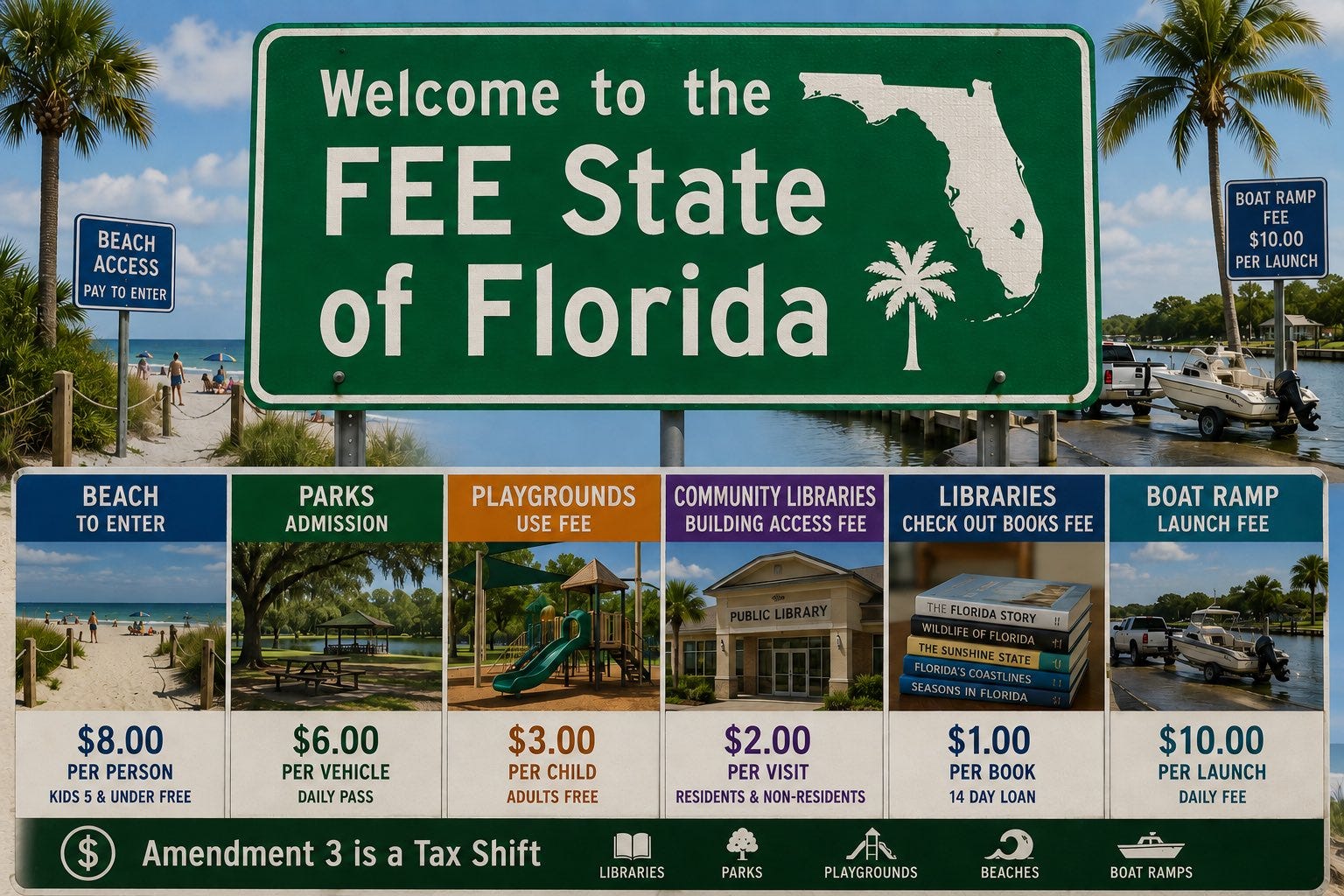
If you don’t use a library, you might shrug at library hours. But for the person using the library to apply for jobs, print documents, study, or give their kids access to books they can’t afford, that building is essential. If you don’t own a boat, you may not care about ramps or slips. But I get the emails, hundreds of them, asking for those boat improvements because that’s part of how people enjoy living here.
Same with animal welfare, veterans, parks, trails, pickleball, soccer fields, swim programs, aquatic centers, and yes, even shuffle board. But this is the local government’s job: balancing a community’s needs with a finite amount of money, knowing that each of these “non-core” items is someone else’s definition of essential.
And when you’re funding locally, you can show up, argue your case, email, call, and vote us out if we don’t listen. You control the local process because it’s local.
Issue: The Debt Service Timebomb
This part of the conversation doesn’t get nearly enough attention.
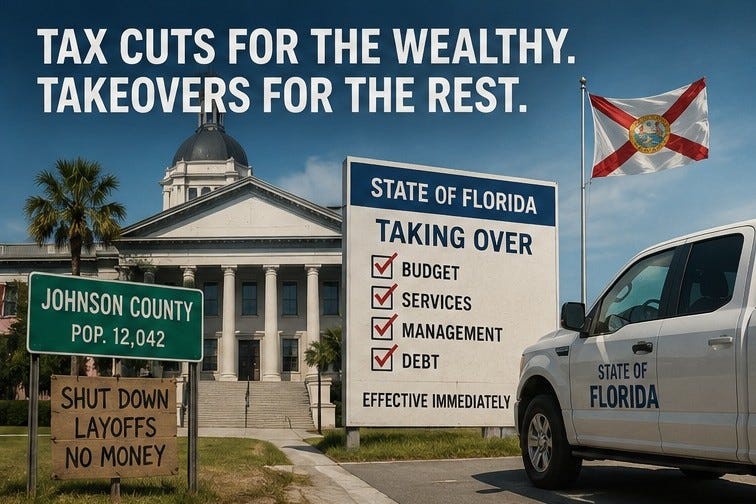
As I mentioned, we have $44 million in debt service payments annually. Our bonds weren’t sold on good faith and good looks; they came with covenants. Covenants require coverage tests tied to revenue. If revenues drop dramatically, you can breach those covenants, which damages credit ratings, raises interest costs across municipalities, and, in worst cases, trigger defaults or restructuring.
Think about what that means in practice. More of whatever revenue remains has to be diverted to pay increasingly expensive debt on projects that are already built and already being used. Future borrowing costs, whether for infrastructure or storm recovery, become more costly to municipalities, resulting in less borrowing capacity.
Who is going to backstop this debt? Who is going to pay down existing bonds to get back into compliance with covenant tests? Who’s going to put their credit behind future borrowing needs after a hurricane? We may be talking about billions of dollars of repayment and defeasance to avoid catastrophic defaults throughout the state.
We may have no path forward to avoid default except to ask Tallahassee for help - on whatever terms Tallahassee sets.
Issue: What About Renters?
This proposal is entirely a financial benefit for homeowners.
The $4.6 billion in initial savings, growing to $8.4 billion annually, goes exclusively to current homesteaded property owners. Renters see nothing, except potentially higher rents as commercial property owners adjust, a menu of potential new fees from counties trying to plug the revenue gap, and degraded services.
If the goal was actually broad affordability relief for everyone, not just homeowners, there was a much simpler, less regressive option.
Florida’s state sales tax collections are projected to exceed $42 billion for FY 2026-27. That’s more than $7 billion per percentage point and growing. A 1% reduction in the state sales tax (from 6% to 5%) would have delivered roughly equivalent affordability relief, faster, without a constitutional amendment, benefiting ALL Florida residents.
But that would reduce state revenue. This current proposal reduces local revenue. Those are very different things, and the choice between them wasn’t accidental.
To his credit, House Speaker Danny Perez actually proposed this sensible alternative with a reduction of sale tax to 5.25% in 2025 (estimated at $5 billion in annual savings and growing). It died due to the threat of veto.
Issue: Growth Without a Tax Base
Here’s an unintended consequence that some current Florida residents may actual support.
Local governments often justify approving new development by pointing to the expanded tax base to pay for the future funding for parks, libraries, trails, EMS, and infrastructure that offsets that growth’s impact. It’s never a perfect equation, but there’s a real logic: new development funds the services new residents need.
If the new proposal limits, or entirely eliminates, taxes on for-sale residential homesteaded properties, what’s the rationale for approving ANY new single-family developments? Every new home would need to be entirely subsidized by renters, commercial property owners, and the “millionaires and billionaires” to fund every service those new residents require and demand.*
There’s no structural incentive. We may find our communities drifting toward rental-heavy, commercial-heavy development patterns that would fundamentally change the community character that attracted people to move here.
The proposed wealth transfer to homeowners only has so much money in the pot and we cannot subsidize everyone forever.
* Yes, conservative Florida’s proposal to bridge the local funding gap went full Horseshoe Theory when proposing to tax second homes and “tax someone rich” by taking the playbook and narrative of NYC’s Democratic Socialist Mayor Zohran Mamdani.
The Actual Issue: Control
The biggest issue with this proposal is big government control.
Local government isn’t perfect, but it is close to you. You can replace your entire county commission over two election cycles. You can push for a millage cut, and you can see the results quickly or vote to change your representation. That’s the conservative view of small government closest to the people.
With a state-controlled system, you’re forgoing the most meaningful revenue stream and hoping it comes back in the amounts you need, on the timeline you need, with no strings attached when you have an inevitable shortfall.
When you shift the primary revenue stream to state control, you’re betting your quality of life on whoever happens to be in charge in Tallahassee, today and decades from now. It’s a long-term handoff of leverage over your core services.
Today, the strings might align with your politics. Ten years from now, with different leadership, different priorities, and different ideological pressures, those strings could look completely different. Library collections. Environmental rules. Local housing policies. Charter school approvals. Development moratoria. They are all potential leverage points for a state that controls whether your county can fund your quality of life and safety.
Tax rates can be changed by voting in new commissioners. Local control, once surrendered to the state constitution, does not come back easily. Be careful what you wish for.
What’s the Track Record on State Control?
We’ve already seen the state take more and more control over housing, infrastructure and growth management through preemptions and overreach WITHOUT the funding threat.
For over 20 years, starting in 2001, the Florida Legislature swept over $2.2 billion collected in the Sadowski Housing Trust Fund to balance their budget. That was supposed to go toward affordable housing. After refusing to give our doc stamp funds back to create housing, they claimed THEY needed to fix what WE broke, and you got the Live Local Act.
They removed infrastructure concurrency and replaced it with impact fees. Then local governments were restricted on what they could collect in impact fees without “extraordinary circumstances”, causing statewide infrastructure backlogs.
At the same time, growth policies pushed from the state result in more development “as of right” and made sprawl easier in ways that don’t always match local capacity. Do we even need to talk about SB180?

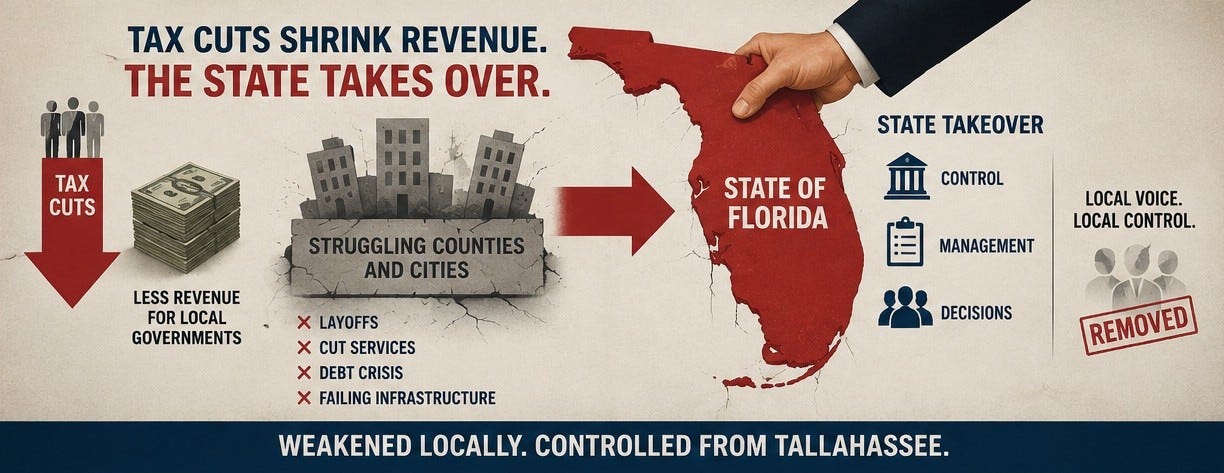
The pattern is always the same: restrict/capture local revenue, redirect it to Tallahassee’s priorities, criticize local governments for the resulting problems, and then solve those problems by taking more control away.
When someone says, "Don't worry, Tallahassee will handle this," it's fair to ask: based on what track record, and with what guarantee of local voice?
We should treat this for what it is: not just a tax question, but a governance question.
Between Now and November
This goes to the November ballot. That means the real public debate starts now. And despite the rushed special session, there’s still time for Floridians to understand what they’re actually voting on.
The state is projecting deficits in coming years. The trust fund was removed from this bill because nobody could explain how to fund it. If you’re betting your community’s quality of life on a state appropriation that doesn’t yet exist, in a budget climate that’s already under pressure, you’re making a faith-based financial decision.
That’s not a plan. That’s a hope.
Before you vote, here are the questions I’d want answered: What happens to voter-approved millage that fund programs your community specifically asked for like children services and environmental land conservation? What’s the actual plan (not the hope, the plan) for rural counties with no commercial tax base? What happens to fire district funding, mosquito control, hospital districts? What benefit will our Floridian renters receive? What protects bond covenants and credit ratings when revenues drop? And who, exactly, is accountable when the shortfalls hit?
I’m not telling you how to vote. I’m telling you there are more questions than answers, and the timeline was designed to prevent those questions from getting answered before the vote. A decision this consequential, one that could reshape how Florida funds local services for decades, deserved a year or two of serious public analysis, not a sprint through a special session.
Around here, people demand multiple public meetings over a minor traffic circle. This particular change got less scrutiny than a roundabout.
Think about that before November.


Spot on, this is a long term power play to consolidate power to Tallahassee.
You tell it like it is sir. We appreciate it!